
If you’ve ever looked at the Mediterranean summer sun and thought, “Ah yes, a giant flaming ball of enthusiasm, directly above my head,” then welcome – you’re already qualified to start a food forest Mediterranean style.
Because here’s the honest truth: a Mediterranean food forest is not about fighting the climate.
It’s about designing with it.
Hot, dry summers.
Monsoon-like bursts of rain in autumn and winter.
Wind that can turn your basil into confetti.
And the occasional moment where everything looks slightly dramatic, including you.

This guide is for beginners who want to grow more food and create a resilient, low-stress edible landscape – without turning it into a second full-time job. We’ll keep it practical, a bit cheeky, and very focused on what actually works in dry summers.
If you haven’t read it yet, this pairs well with:
- Permaculture Italy: What Beginners Need to Know Before Starting in a Mediterranean Climate: https://lavitasukha.com/permaculture-italy-mediterranean-climate-beginners/
- Rural Living in Italy: What to Expect (and How to Do It Sustainably): https://lavitasukha.com/rural-living-italy-what-to-expect/
What a food forest Mediterranean style actually is (and what it is not)
A food forest Mediterranean garden is basically an edible ecosystem: trees, shrubs, herbs, groundcovers, climbers, and roots working together, like a tiny village where everyone has a job and nobody holds pointless meetings.
It is not:
- A chaotic jungle you can never walk through
- A Pinterest fantasy that requires unlimited irrigation
- A “plant it and abandon it” situation (sorry)
It is:
- A layered edible system
- Designed to create shade, protect soil, and reduce watering over time
- Built slowly, with observation and good timing
If you remember one thing: in a food forest Mediterranean climate, shade is not aesthetic. Shade is survival.
Why dry summers change everything
Mediterranean climates tend to have rainfall when plants are not desperate for it (winter) and dryness when they are (summer). So Mediterranean climate gardening often comes down to one question:
How do I keep water in the system for longer?
That means:
- Slowing water down
- Getting it into the soil
- Keeping soil covered
- Building shade and wind protection
- Choosing plants that are not personally offended by summer
For background on drought and water trends in Europe, the European Environment Agency is a solid resource: https://www.eea.europa.eu/en/topics/in-depth/water
Start with “Water-first” design (before you buy one single tree)
The biggest beginner mistake with a food forest Mediterranean garden is buying trees first and designing later. It feels exciting, but it’s like buying furniture before you know where the doors are.
Start with water.
1. Observe where water flows and pools
After a proper rain, walk your land and look for:
- Where water runs fast
- Where it ponds
- Where it erodes soil
- Where it naturally soaks in
Even a small observation like “this corner stays damp longer” can guide smarter planting.
2. Slow, spread, sink (the holy trinity)
You want rain to:
- Slow down
- Spread out
- Sink into the soil
You can do this with simple, low-tech moves:
- Small basins around trees (not volcano mounds)
- Mulch rings that hold moisture
- Planting on contour where possible
- Swales or terraces only if you understand your slope and local context
If you’re going bigger with earthworks, the FAO has good context on water and land management approaches: https://www.fao.org/land-water/en/
3. Mulch like your garden depends on it (because it does)
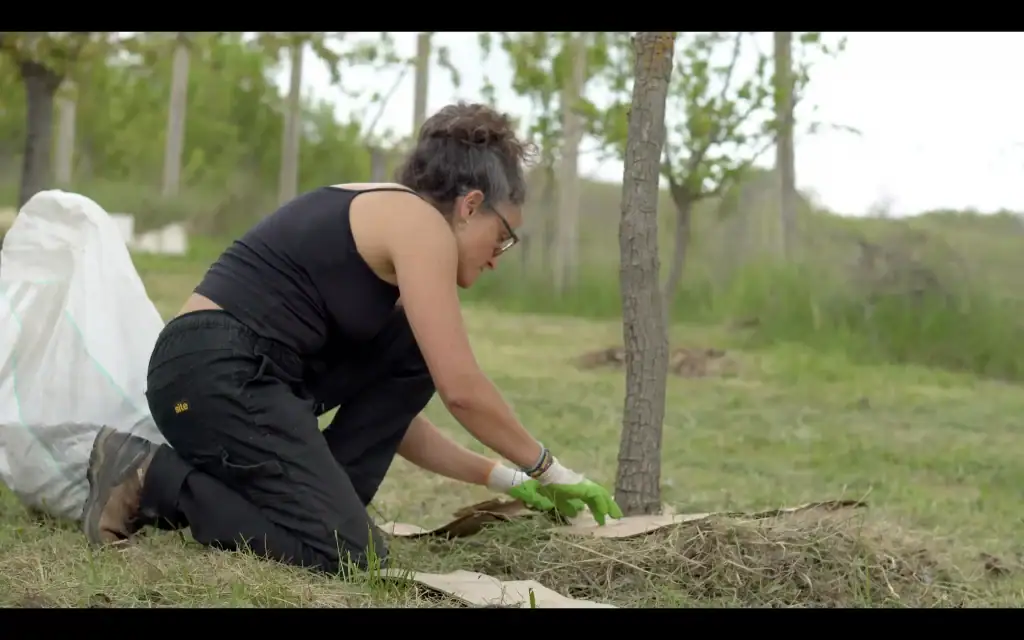
Mulch is basically a tiny duvet for your soil. In a food forest Mediterranean climate, bare soil is an open invitation for evaporation and weeds.
Use what you can access:
- Straw
- Wood chips
- Leaves
- Prunings (chop-and-drop)
Aim for consistency over perfection. A slightly messy mulch situation is usually a sign of a thriving garden.
The layers of a Mediterranean food forest (simple version)
A food forest Mediterranean design is built in layers, like a lasagna you can eat from (with fewer arguments about which ingredients should and shouldn’t be included).
Canopy layer (big trees)
Examples: Carob (warm sites), mulberry (site dependent), chestnut (cooler/higher areas)
Low tree layer (productive fruit)
Common Mediterranean winners:
- Fig
- Pomegranate
- Olive
- Almond (site dependent)
- Apricot and peach (needs care and variety selection)
- Citrus (warmer microclimates, frost protection)
- Grape vines (often behave like a tree if trained well)
Shrub layer
- Rosemary (also a legend as a pollinator plant)
- Lavender
- Sage
- Myrtle (in some regions)
- Berries can work in cooler microclimates with water support
Herb layer
- Thyme
- Oregano
- Basil (more summer water)
- Chives
- Calendula (useful and pretty, also makes you look like you know what you’re doing)
Groundcover layer
- Strawberries (with water)
- Nasturtiums (if not too dry)
- Creeping thyme
- Sweet potato as seasonal groundcover in warm areas
Root layer
- Garlic
- Onions
- Jerusalem artichoke (can get enthusiastic)
Climber layer
- Grapes
- Passionfruit (warm areas)
- Beans climbing through support plants (seasonal)
The point is not to plant everything. The point is to build a food forest Mediterranean system where each layer helps the others.
Plant choices: pick the ones that want to live here
A food forest Mediterranean garden is not the place to start with thirsty divas unless you love constant watering and heartbreak.
Choose:
- Drought-tolerant trees and shrubs
- Deep-rooted perennials
- Support species that build soil and create shade
- Herbs that thrive on neglect (the dream)
A simple rule: if a plant needs daily watering forever, it’s probably not your main character in a Mediterranean system.
The support species nobody brags about (but they should)
Support species are the quiet heroes of food forest Mediterranean design. They:
- Fix nitrogen
- Create mulch
- Provide shade and wind buffering
- Improve soil structure
Examples (site dependent, check invasiveness locally):
- Tagasaste (tree lucerne) in some Mediterranean contexts
- Certain acacias are used in some places but can be invasive, so proceed with caution
- Local legumes and cover crops
- Comfrey is popular in permaculture, but it may struggle in very dry sites unless irrigated
Support species are how you make the system easier over time. They are also how you avoid becoming the full-time water carrier.
Timing: the Mediterranean cheat code is autumn planting
If you’re building a food forest Mediterranean garden, autumn planting is your friend.
Why?
- Soil is still warm
- Rain starts to return
- Roots establish through winter
- Summer stress is lower in year one
Spring planting can work, but you’re basically introducing a baby tree right before summer and saying, “Good luck, mate.”
A beginner-friendly first-year plan (so you don’t burn out)
Here’s a realistic way to start a food forest Mediterranean project without turning it into chaos.
Step 1: Design your access first
Before planting, decide:
- Where you will walk
- Where you will wheelbarrow
- Where irrigation lines might go
- Where you need space to prune and harvest
Food forests fail when you can’t reach anything without crawling through rosemary like it’s a hedge maze.
Step 2: Start with 3 to 7 key plants
Pick a small number of core productive trees that suit your site. For example:
- 1–2 figs
- 1 pomegranate
- 1 olive or almond (site dependent)
- A grape vine or two
Then add a few shrubs and herbs around them.
Step 3: Build the “donut” around each tree
Around each tree:
- A basin to catch water
- Mulch thickly
- Plant herbs and groundcovers that reduce evaporation
- Add a support plant if appropriate
This is the classic food forest Mediterranean starter move: create microclimates one tree at a time.
Step 4: Irrigate smartly in year one (then reduce)
Drip irrigation can be a lifesaver for establishment. The goal is not to irrigate forever. The goal is to:
- Establish deep roots
- Build soil that holds water
- Create shade that reduces demand
Think “training wheels,” not “life support.”
Common mistakes (so you can skip them)
Here are the classics in food forest Mediterranean gardens:
- Planting too densely too soon
Trees grow. Future-you deserves sunlight and airflow.
- Leaving soil bare
Bare soil is basically a heat mirror.
- Ignoring wind
Dry winds can undo your watering in a day. Windbreaks matter.
- Planting water-hungry plants in full sun
Some plants need afternoon shade here, no negotiation.
- No maintenance rhythm
A food forest is not high-maintenance, but it is consistent-maintenance.
Maintenance that actually feels doable
A food forest Mediterranean garden thrives on simple recurring actions:
- Mulching 2–4 times a year
- Light pruning to manage shade and airflow
- Chop-and-drop with prunings
- Adding compost around key plants
- Adjusting irrigation seasonally
It’s less “gardening all weekend” and more “steady, gentle stewardship.”
Want to experience rural life and this kind of rhythm first?
If you’re curious about Mediterranean living and a slower, land-connected rhythm, one gentle way to test it is through a coliving stay.
La Vita Sukha offers coliving and seasonal stays in rural Puglia where you can work remotely, slow down, and experience countryside life without pressure:
- Coliving & Stays: https://lavitasukha.com/coliving-italy/
And for the related reading mentioned earlier:
- Permaculture Italy beginners guide: https://lavitasukha.com/permaculture-italy-mediterranean-climate-beginners/
- Rural living Italy guide: https://lavitasukha.com/rural-living-italy-what-to-expect/
The simple truth
A food forest Mediterranean garden is not built in a weekend. It’s built like a good relationship: slowly, with attention, and with fewer dramatic decisions made in the heat of summer.
Start small. Design for water. Cover your soil. Choose plants that actually like living where you live. And if your first attempt looks a bit chaotic – congratulations, you’re doing the most Mediterranean thing possible: learning by living.